One of the clearest indie hacker lessons I've seen play out publicly: fabricating metrics feels like a small thing until it becomes a documented record you can't quietly leave behind.
A founder recently admitted on X that he lied about his company's metrics to a journalist. He got a cold call, told her "some bs," and didn't think much of it — until it became a published article.
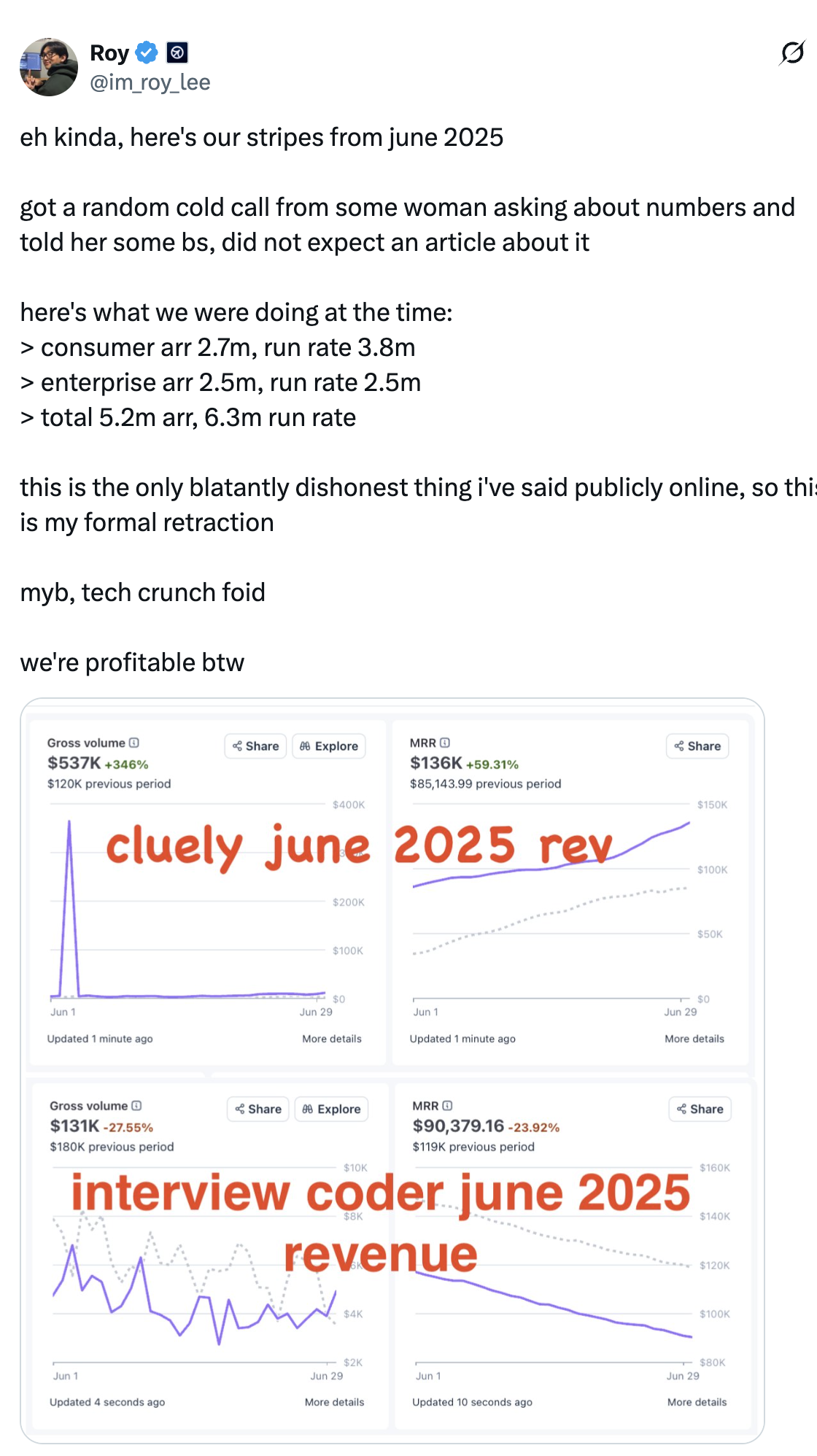
He's since retracted it. Shared the real Stripe numbers. Called it the only "blatantly dishonest thing" he's said publicly online.
Cool. But let's not move past it that fast.
The private company problem
Public companies lie and get destroyed. Theranos. Enron. The SEC, shareholders, auditors — there are systems specifically designed to punish fraud at scale.
Private companies? Different story.
When a private founder tells a journalist their ARR is $5.2M with a $6.3M run rate and the real number is closer to $1.6M — nobody can fact-check that in real time. There's no 10-K. No quarterly earnings call. No public filing.
The journalist publishes. The article runs. People read it and form a belief about how well this product is doing.
That belief shapes decisions. Whether to use the product. Whether to trust the founder. Whether to take the company seriously as a signal in their industry.
All of it built on a number someone made up on the phone.
The "it's just hype" rationalization
There's a version of this that gets rationalized as founder bravado. Fake it till you make it. Speak it into existence. Every successful founder stretched the truth at some point.
No. There's a difference between being optimistic about your trajectory and fabricating a metric to a journalist writing about you.
One is conviction. The other is deception.
And the people on the receiving end of that deception — readers, potential customers, other founders benchmarking themselves against your numbers — didn't sign up to be misled. They were trying to get accurate information about the world. You took that from them.
Why transparency is the only policy I'll hold
I'm building alone. No team to hide behind. No PR department to manage the narrative. If something goes wrong, it's visible. If numbers are bad, that's the reality.
That's actually a gift.
It means I have no incentive to build a false image, because there's no organization that benefits from the fiction. It's just me and the work. Either it's real or it isn't.
My commitment is simple: I will never misrepresent what I'm building. Not to journalists. Not on social media. Not in pitch decks. Not to users.
If growth is flat, I'll say it's flat. If I made a mistake, I'll say I made a mistake. If something isn't working, I'd rather say that out loud than pretend otherwise and have someone trust me based on a lie.
Honesty is hard when things aren't going well
That's exactly when it matters most.
Anyone can be transparent when the numbers are great. The real test is whether you'll say something true when it's inconvenient — when the journalist is asking and the real number is embarrassing, when users are watching and the launch flopped, when the narrative you've built publicly doesn't match the reality you're living privately.
The founder in this story did eventually tell the truth. That's worth something. But he only did it after the article came out, after the fiction became a documented public record he couldn't quietly leave behind.
Transparency isn't a retraction. It's a default.
What I want builders to know
If you're early and your numbers are small — say that. Small numbers with honest context are more compelling than big numbers that don't hold up to scrutiny.
If you lied about something, the retraction has to come before you get caught, not after. Anything else is just damage control with honesty branding.
And if you're a user or reader evaluating a product, a founder, or a company — remember that private companies face almost zero accountability for what they claim. The burden of skepticism is on you. Honest founders exist and are worth finding. But you have to look for the receipts, not just the story.
The broader indie hacker lesson here connects to shipping before you're ready: the goal is to build in public in a way that creates compounding trust, not compounding fiction. The founders people root for are the ones who share the real journey — including the ugly parts.
I'll always show the receipts. That's the only version of building I know how to do.
Frequently asked questions
Why do indie hackers build in public with real numbers? Building in public with real numbers creates accountability, builds audience trust faster than polished marketing, and attracts the right early customers and collaborators. Small honest numbers are still more compelling than big vague claims — because anyone with experience can spot the difference.
What are the risks of lying about startup metrics? For private companies, the immediate legal risk is low. But the real damage is reputational: fabricated metrics attract customers who will be disappointed by reality, create a narrative you have to maintain indefinitely, and eventually surface as a documented lie. The retraction is always worse than the truth would have been.
What should an indie hacker be transparent about? Revenue numbers, customer counts, growth rate, mistakes, failures, and what's not working. Small honest numbers with context are more credible than large vague claims. Transparency compounds — people who follow your journey from early days become your most loyal customers and advocates.
How should founders handle press inquiries about revenue? Share the real number with context, or decline to share specific metrics and explain why. A journalist will publish what you say. Once a fabricated number is in print, retracting it makes things worse. The moment to tell the truth is always before the story runs.
Is 'fake it till you make it' a valid startup strategy? There's a version that works: projecting confidence in your direction before results confirm it. There's a version that doesn't: fabricating specific metrics to journalists or investors. The first is conviction. The second is deception — and everyone benchmarking against your numbers is making decisions based on false data.